March 19, 2026 | 10:13 am
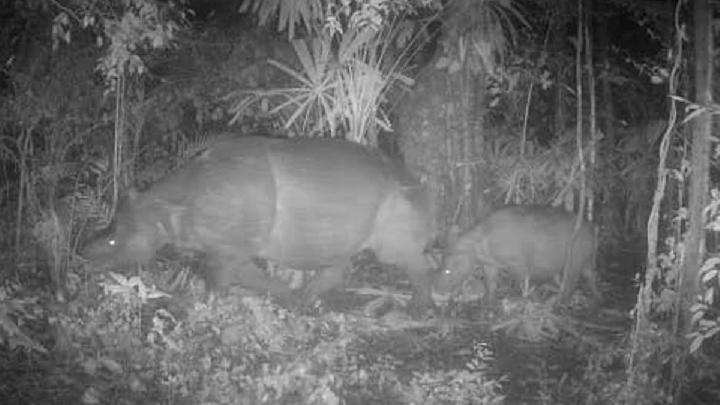
A Javan rhino met a fatal end following its translocation in the Ujung Kulon National Park. There are lingering questions.
SUSPICIOUS circumstances surround the death of a Javan rhino (Rhinoceros sondaicus) named Musofa at the Ujung Kulon National Park, Pandeglang, Banten. The incident took place on November 7, 2025, but the Ujung Kulon National Park Agency only announced it to the public 20 days later. Musofa was the first rhino to be translocated from its original habitat to the in situ conservation facility at the Javan Rhino Study and Conservation Area at the foot of Mount Honje.
Musofa was indeed successfully moved to his destination, but the male rhinoceros estimated to be over 45 years old only lasted two days in his quarantine enclosure. According to the National Park Agency, Musofa’s necropsy shows that his death was caused by chronic weaknesses suspected to have been present before translocation.
However, a series of incidents during transfer has prompted questions. Musofa was caught in a pit trap on Monday night, November 3, 2025, and was moved to his transport enclosure the next day. The journey to the conservation center at the foot of Mount Honje was delayed for one whole day because its transportation, a K-61 amphibious combat vehicle owned by the Indonesian Navy Marine Corps, had its tracks stuck in the ground. Towing failed because another K-61 sent to the area also broke down at Gardaburuk Beach.
During the wait, Musofa was in a narrow enclosure—only a little larger than his 1.7-ton body. To prevent a tantrum, the rhino was injected with sedatives nine times. Furthermore, the transportation vehicle was not new but rather an amphibious vehicle already used since Operation Trikora in the 1960s.
The Forestry Ministry reasoned that the Navy’s amphibious fleet was capable of traversing land, beach, and sea to haul the heavy loads required for rhino translocation. However, within the command structure of Musofa’s translocation team, the military’s role extended beyond security or logistics; they occupied pivotal decision-making seats. The Indonesian Military (TNI) Chief of Staff’s Operations Assistant, for instance, served as the person in charge of operations. Several other TNI officers were listed as part of the core team—and even the expert team—for the relocation.
The team composition stands in stark contrast to the 2018 rescue of a Sumatran rhino named Pahu in East Kalimantan. In moving Pahu from the forests near the Tunuq River to the Kelian Lestari Protected Forest, the government collaborated with rhino rescue specialists from the International Union for Conservation of Nature (IUCN). The operation also involved the International Rhino Foundation and the World Wildlife Fund (WWF). The involvement of the scientific community and conservation organizations ensured that Pahu’s translocation was relatively transparent and held to clear standards of accountability.
Relocating endangered animals is not merely a logistical operation, but it is also a scientific work that demands expertise and field experience. It is, therefore, only natural that Musofa’s death has eroded public trust in the authorities tasked with protecting the Javan rhino. Resistance has even emerged against future translocation plans, out of concern that a similar tragedy would strike.
A comprehensive evaluation of Musofa’s death must be performed openly. Each translocation of an endangered species must be prepared with solid science-based planning and by involving the broader conservation community. Without such measures, operations meant to save endangered animals may run the risk of sacrificing them instead.
Translocated Javan Rhino Dies Just Days After Reaching Conservation Area
27 November 2025
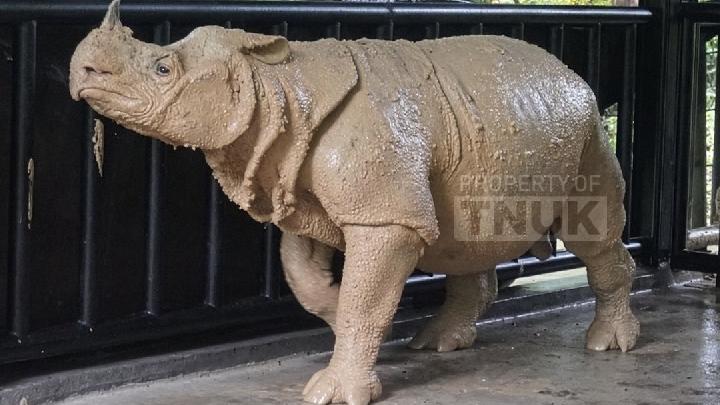
The clinical condition of Javan rhinoceros Musofa has declined 2 days after arriving at the special conservation area. Ujung Kulon National Park Agency reveals the cause of death according to necropsy results.
Safeguarding Ujung Kulon's Last Javan Rhinos
19 Oktober 2025

Biodiversity as a supporter of ecotourism in national parks currently needs special attention, including the survival of the Javan rhinoceros.
Indonesia's Ujung Kulon National Park Flags 3 New Javan Rhino Calves
4 Mei 2025

The discovery of new Javan rhinos highlights the effectiveness of the 'Spatially Explicit Model' system in Ujung Kulon National Park.
Javan Rhino Poachers in Ujung Kulon National Park Sentenced to 12 and 11 Years in Prison
13 Februari 2025

Six Javan Rhino poachers are found guilty of poaching the Javan rhinoceros, which is considered a rare and protected species.
Indonesia's Ujung Kulon National Park Welcomes Birth of 3 Javan Rhino Calves
30 Agustus 2024
Indonesia's Ujung Kulon National Park welcomes three new calves of Javan rhinos.
Two Baby Javan Rhinos Born in Banten's Ujung Kulon National Park
20 September 2020

The Indonesian Environment and Forestry Ministry announced the birth of two Javan rhinos in the Ujung Kulon National Park, Banten Province.
Javan Rhino Population in Ujung Kulon National Park Increases
13 Desember 2019

As many as four Javan rhinoceros were born at Ujung Kulon National Park (TNUK), Banten, according to the park management head Anggodo.
Poaching Not Likely Cause of Javan Rhino Death in Ujung Kulon
30 April 2019

The cause of a Javan rhino's death at the Ujung Kulon National Park is said to be from reasons other than poaching, says a Ministry official.
Javan Rhino Found Dead in Ujung Kulon
27 April 2019
Ujung Kulon National Park (TNUK) confirmed that it recently found a dead Javan rhino at its last habitat in the national park, Banten.