TEMPO.CO, Jakarta - Law Number 17 of 2025 concerning Indonesia's State Budget (APBN) for Fiscal Year 2026 is currently being challenged in the Constitutional Court (MK). The plaintiffs argue that this year's APBN is unconstitutional because it includes funding for the free nutritious meal program (MBG) within the national education budget structure at a minimum of 20 percent.
The petition for judicial review was filed by the Taman Belajar Nusantara Foundation (TB Nusantara), along with three students and an honorary teacher. The petition was filed in late January 2026.
The judicial review process is currently underway at the Constitutional Court. The following are the points of the lawsuit:
MBG Budget Allocation Deemed Problematic
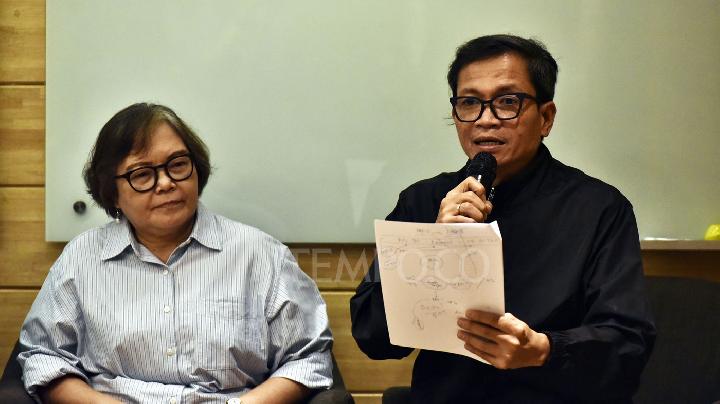
The plaintiffs' attorney, Abdul Hakim, stated that this judicial review is being conducted to uphold the mandate of Article 31 paragraph (4) of the 1945 Constitution. "This article requires the state to prioritize the education budget at least 20 percent of the APBN to meet the needs of national education," said Abdul Hakim.
According to the judge, the provisions of Article 22 paragraph (3) and its explanation in the 2026 State Budget Law have broadened the meaning of operational funding for education to include financing for the MBG program. However, he stated, this program is not directly related to the core function of education.
The petition explains that of the total 2026 education budget of Rp769.1 trillion, approximately Rp223 trillion is allocated for the free meal of the MBG funding. This means that nearly 29 percent of the education budget is absorbed by this program.
"This budget shift reduces fiscal space for more pressing education needs, such as improving teacher quality, school facilities, educational assistance, and ensuring equal access to education," he said.
In their petition, the petitioners ask the Constitutional Court to declare Article 22 paragraph (3) of the 2026 State Budget Law unconstitutional insofar as it is interpreted to include the nutritious meal program, and to revoke the explanation of the article for illegally expanding the norm.
Petitioner Does Not Reject MBG
Abdul Hakim stated that this petition is not to reject the free meal or the MBG program, but rather to ensure that the program does not overlap with the education budget, which is constitutionally mandated to be prioritized for the implementation of national education.
"The education budget is a constitutional mandate that cannot be fulfilled formally. If a large portion is diverted to programs outside of core education, the right to a decent and quality education will be threatened," he said.
He said the practice of including nutritious meal programs in the education budget is a policy not found in many countries.
Brazil, he said, explicitly prohibits supplementary programs such as food assistance and health services from being included in the education budget. Similarly, in the United States, school lunches are not included as part of the education budget, but rather as a public health and food security policy under the jurisdiction of the Department of Agriculture (USDA).
"This means that even though meal programs for students are considered important, legally and budgetarily they remain outside the education regime," he said.
Decrease in Education Budget in the 2026 State Budget
According to data held by the legal team for the free meal or the MBG budget plaintiffs at the Constitutional Court, several education components experienced a decrease in allocation after the MBG project was included in the 20 percent education budget scheme in the State Budget.
In total, the education budget did increase from Rp724.26 trillion in 2025 (Presidential Regulation 201/2024) to Rp769.08 trillion in 2026 (Presidential Regulation 118/2025). However, the significant increase in the National Nutrition Agency's allocation for MBG, amounting to Rp223.55 trillion, is considered to have changed the composition of spending and displaced other fiscal space for education.
In 2025, the education budget for the National Nutrition Agency was recorded at Rp56.8 trillion. In 2026, the figure jumped to Rp223.55 trillion. This nearly fourfold increase represents the largest component of education spending by ministries/agencies.
As a result, despite the aggregate increase in the education budget, several ministries and other education items experienced cuts. According to data provided by the attorneys for the MBG budget plaintiffs, several ministries experienced a reduction in their education budgets.
The most significant change was seen in the education budget through transfers to regions. Total education transfers to regions decreased from Rp347.09 trillion in 2025 to Rp264.62 trillion in 2026.
The education budget through financing also experienced significant cuts. Total education funding decreased from Rp80 trillion in 2025 to Rp34 trillion in 2026.
Indonesian Gov't and House of Representatives Claim MBG Did Not Use Education Budget
Minister of Primary and Secondary Education Abdul Mu'ti claimed that the free meal or the MBG program did not reduce his ministry's education budget. He ensured that strategic education programs would continue and even be expanded in 2026.
"If there are allegations that the MBG is reducing the education budget, we firmly state that this is not true. The president's education programs will continue to be implemented as well as possible," said Mu'ti at the MBG Program Implementation Coordination Meeting in East Java on Thursday, February 19, 2026.
Mu'ti gave examples of several education programs whose budgets either increased or remained unchanged in 2026. These include school revitalization and the Smart Indonesia Program (PIP).
Meanwhile, Lalu Hadrian Irfani, Chairman of Commission X of the House of Representatives (DPR), claimed that education funds in the state budget were not used for MBG project operations. According to Lalu, Commission X of the House of Representatives, which is a working partner of the Ministry of Education, has not found evidence that the education budget was allocated for MBG implementation.
"We know that the education budget is not being taken by the MBG," said the National Awakening Party politician at the House of Representatives Complex in Jakarta on Friday, February 20, 2026.
Luna dismissed the notion that teacher welfare was due to the education budget being diverted to President Prabowo Subianto's priority programs. He believed that the 20 percent allocation of the state budget (APBN) was still intact for the education sector, including teacher welfare. Therefore, he asked the government to use the available budget to improve teacher welfare.
Dian Rahma Fika Alnina, Dinda Shabrina, and Hendrik Yaputra contributed for this article.
Read: Minister: Free Nutritious Meal Program Won't Cut Education Funds
Click here to get the latest news updates from Tempo on Google News