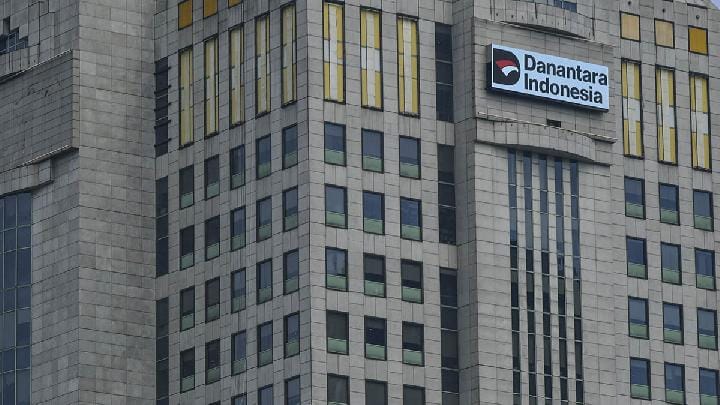
TEMPO.CO, Jakarta - Global rating agency Moody's Ratings has assigned a Baa2 issuer rating for the first time to PT Danantara Investment Management (DIM), while simultaneously attaching a negative outlook in line with the outlook for Indonesia's sovereign debt rating.
Moody's also assigned a Baa2 provisional rating to DIM's global senior unsecured medium-term notes (MTN) program and a Baa2 rating to DIM's proposed senior unsecured notes issuance, both of which carry negative outlooks.
"Danantara Investment Management's Baa2 issuer rating with a negative outlook is aligned with the sovereign rating of the Government of Indonesia (Baa2 negative), which is supported by strong credit linkages, including its ownership structure within Danantara's institutional framework, and our expectation of timely extraordinary support from the government," Rachel Chua, Vice President and Senior Analyst at Moody's Ratings, stated in an official release in Jakarta on Wednesday, June 3, as reported by Antara.
Moody's explained that DIM's Baa2 issuer rating mirrors the Indonesian government's Baa2 sovereign rating, reflecting the robust credit linkage binding the investment firm to the state.
These linkages include DIM's ownership structure, its role within BPI Danantara, and Moody's clear expectation of timely, extraordinary support from the government.
Furthermore, Moody's classifies DIM as a Government-Related Issuer (GRI) and has applied a top-down analytical approach to its assessment. In tandem with this, no Baseline Credit Assessment (BCA) has been provided, reflecting DIM's nascent stage of development, its limited track record, and a current lack of significant standalone operations.
Rachel observed that thus, the rating is primarily driven by sovereign linkage rather than standalone credit strength. Moody's takes into account the high level of government oversight and deeply integrated governance, which together support a very high probability of timely extraordinary state backing.
Furthermore, this governance integration is reinforced by an overlap in senior management and board representation between BPI Danantara and DIM, a factor that ensures the close alignment of investment strategy and execution.
Moody's assesses that DIM's annual budget, which is consolidated into BPI Danantara's overall financial blueprint and approved by the 11-member BPI Danantara Supervisory Board, including nine active ministers alongside the Chief, will provide a direct channel for state-level oversight of DIM's resource allocation and strategic priorities.
Furthermore, the existing legal framework mandates that DIM's corporate work plans and annual budgets must be consulted with the House of Representatives (DPR).
Multi-Tiered Governance and Strong Liquidity
Moody's notes that DIM's investment decisions are governed by a highly structured approval framework, wherein investment proposals are subjected to a multi-tiered vetting process, moving from DIM's internal Investment Committee to the Board of Directors and Board of Commissioners, and potentially up to BPI Danantara as the sole shareholder, depending on transaction size and materiality.
According to Rachel, this strengthens the depth of oversight of DIM's investment activities.
Moody's further assessed that the financial integration within the overarching Danantara structure bolsters DIM's liquidity and affirms the baseline framework for this institutional support.
Under the group's consolidated cash flow structure, state-owned enterprise dividends are pooled at BPI Danantara and subsequently allocated, with a specific portion injected into DIM as equity earmarked for investment placement.
Moody's further noted that DIM received an initial capital injection of Rp70 trillion in 2025, with an additional Rp50 trillion expected to follow in 2026.
Furthermore, subject to supervisory board approval, BPI Danantara possesses the authority to act as a corporate guarantor for DIM, a mechanism that solidifies the financial relationship within the state architecture.
Fiscal Health and External Funding Channels
Rachel noted that the negative outlook on DIM's rating is aligned with the negative outlook on the Indonesian sovereign rating, reflecting the strong credit linkages between the two.
Moody's assesses DIM's overall liquidity position as very good, heavily supported by the capital injections received from BPI Danantara.
DIM is considered to have already established viable external funding channels, including Rp68.4 trillion raised through the issuance of Patriot Bonds and a US$10 billion revolving credit facility, of which US$1 billion has been firmly committed.
Moody's observes that this revolving credit facility has been partially drawn down for placement in private mutual funds and real estate-related investments, with the agency expecting further drawdowns as capital placements proceed.
"DIM has no obligation to pay dividends and no debt maturities in the next two to three years," Rachel concluded.
Ultimately, Moody's stated that governance considerations remain the absolute key drivers of this inaugural rating. This directly reflects the government's full ownership of DIM through BPI Danantara, alongside the rigorous level of state oversight governing its broader strategy, funding mechanisms, and core investment decisions. "These features support our expectation of timely and extraordinary support from the Indonesian government," Rachel said.
Read: Indonesian Exporters Urge Gradual Rollout of Single-Gate Export Policy
Click here to get the latest news updates from Tempo on Google News